
Three Weeks, Three G-Wagens: In Search of One Perfect Thing
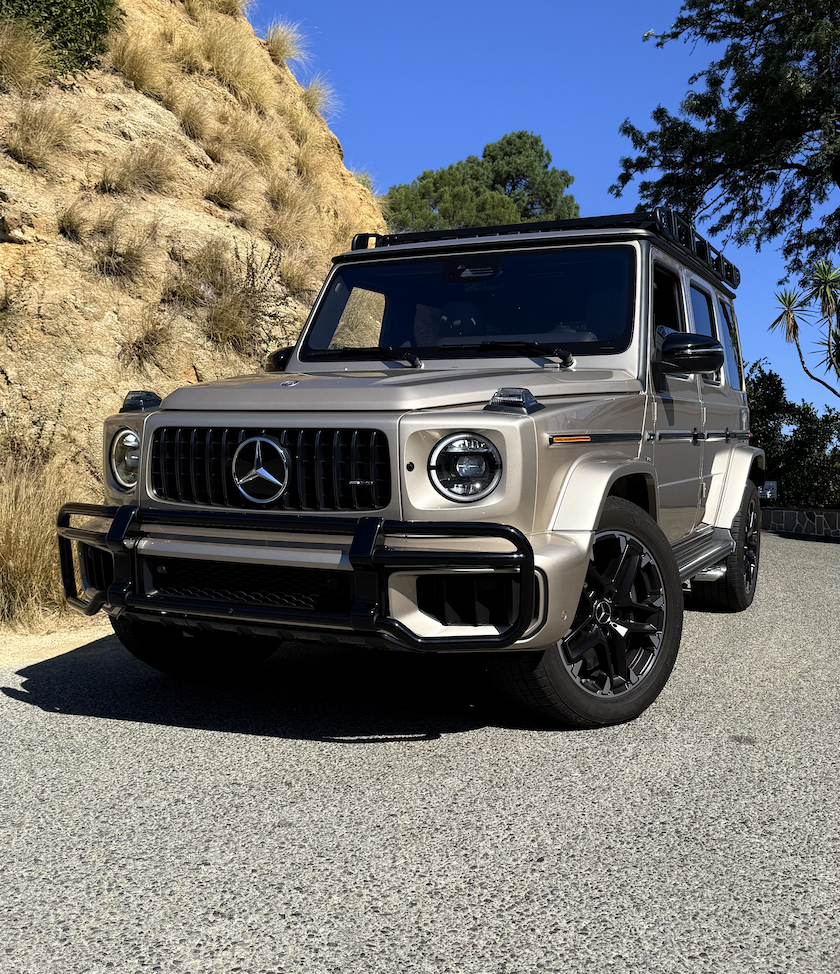
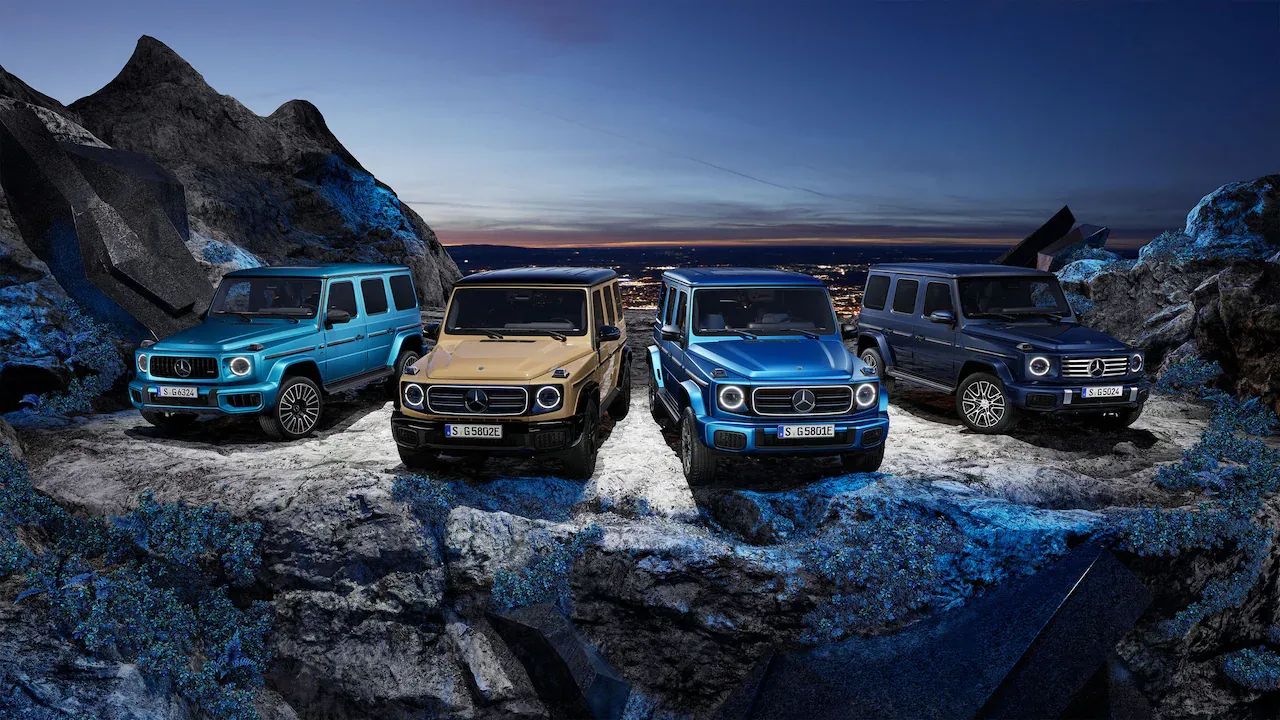
The Mercedes-Benz G-Wagen is such an indelible part of the Los Angeles experience, especially from my vantage point living in Laurel Canyon for more than a decade. Last year, on the drive from my house to a doctor's appointment in Beverly Hills, I counted fifty-seven (57!) G-Wagens of all makes and models, colors and years, in the four or so mile drive. You can add three more to the count as, over the last few months, I had a chance to drive the entire G-Class lineup: the Mercedes-Benz G 550, the Mercedes-AMG G 63 and the newest of the batch, the Mercedes-Benz G 580 with EQ Technology.
French literary theorist and philosopher Roland Barthes published his seminal collection of essays Mythologies in 1957. Barthes was one of the first in a long line of academics to delve into and deeply analyze pop culture.
I include myself in this mishegoss - I went to CalArts, got my MFA in Critical Studies and wrote my thesis on fashion theory with ever-stylish Dick Hebdige as my mentor.
In one of Barthes' essays “The New Citroën” he analyzed the much-maligned and truly loved Citroën DS. Barthes wrote "the object is the best messenger of a world above that of nature" and when writing about the DS said “I think that cars today are almost the exact equivalent of the great Gothic cathedrals…”
That sentiment tracks regarding the DS, but Barthes could have been writing about and with greater alacrity and a modern fidelity, the Mercedes-Benz G-Class. Since 1979, the Geländewagen has asked a singular question, to paraphrase Barthes: Can utility be transmuted into luxury without altering the container?
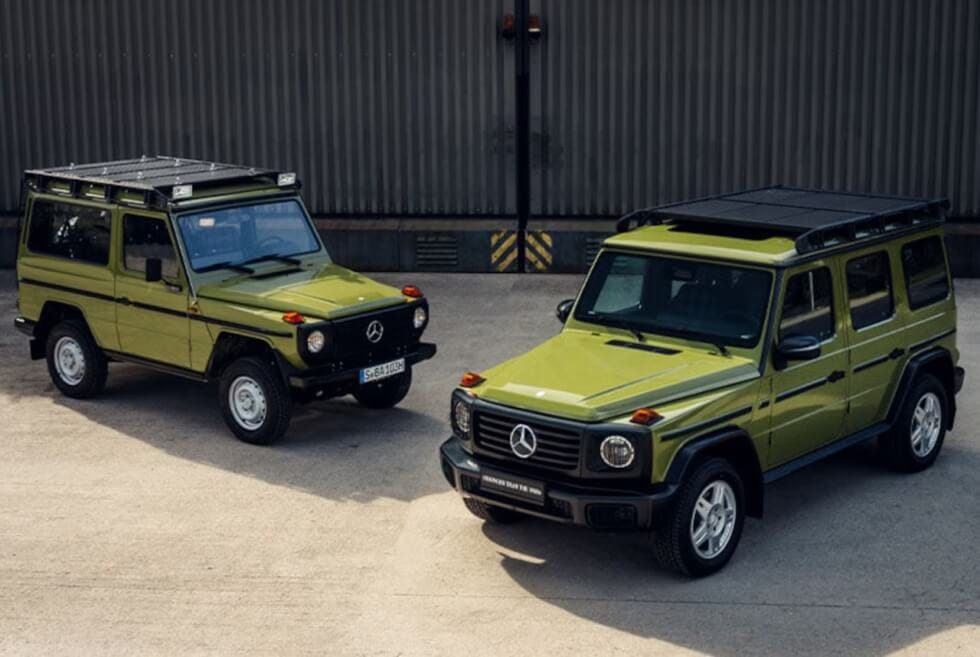
The G’s lineup turns on that singular question and creates three distinct arguments: the electric-powered G 580 with EQ Technology, the gas-powered G 550, and the over-the-top, 4.0-liter twin-turbo V8-powered AMG G 63 with its 577 horsepower and 627 lb-ft of torque.
To me, the G’s aren’t One Perfect Thing (please note: One Perfect Thing is an ongoing column). In fact, they’re Three Perfect Things.
Leaning into that idea, I came to understand that perfection isn’t really a fixed target for Mercedes-Benz with the G, but a series of engineering choices that adds up to a sliding scale between the mechanical past and the digitized future.
While the boxy sexiness of the G’s sheet metal remains a constant—a rectilinear defiance of aerodynamics, a brick in the face of wind resistance, a rolling bank vault devoid of competitors - the underlying mechanics that animate the G’s have never been more divergent. There is a G for everyone!
During the launch of the electric G-Class last year, I asked Michael Schiebe - CEO of Mercedes-AMG GmbH and Head of the Top End Vehicle (TEV) Group -why the G-Wagen remained a perennial favorite among the Hollywood set still with long wait times to acquire one after all these years.
Schiebe told me, “I think it’s because of the DNA of the G-Wagen—it’s a very versatile car and it’s still so special. Although we have upgraded the car to go with the times, the G-Wagen has a character that is so different to what you have in the market, there’s nothing comparable with the G-Wagen and that makes it so special.”
Schiebe then jokingly added, “When I said the car was made for professionals in rescue services, the trades and the military… nowadays, the G-Wagen is still for professionals, but now they’re singers and actors.”
The G-Wagen is part and parcel, sign and signifier of a certain subset of Los Angeles automotive culture. To me, the G is one of the greatest cars ever made, even if in LA some of the drivers can be lacking. Personally, to misquote the aphorism: “Love the cars, hate the drivers.”
Week One: The G 580 with EQ Technology
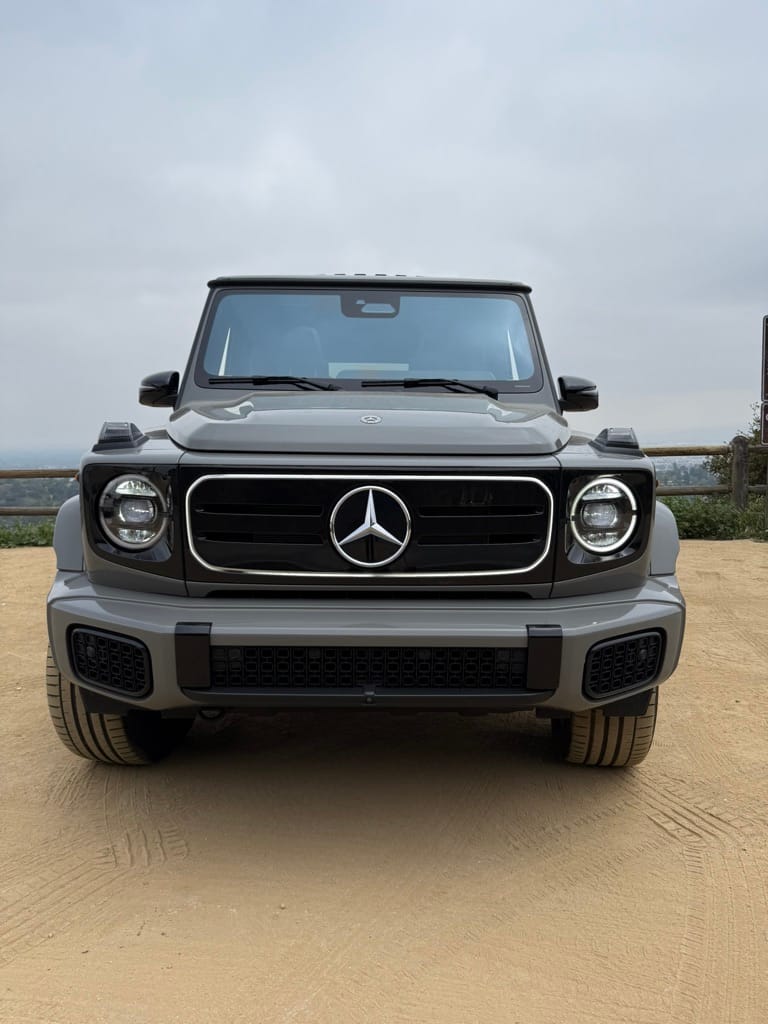
The G 580 EQ I drove was one of the Edition One versions - finished in Manufaktur Arabian Grey over a Silver Pearl and Black Nappa Leather interior.
That flat, resonant grey that absorbed rather than reflected LA’s early Fall overcast gloom. The first thing I noticed wasn’t just the silence, but the mass and density. The electric G weighs about 6,800 pounds, a consequence of the 116-kWh battery pack bolted into the body-on-frame. It sits heavily on its tires, mass waiting to be turned into motion.
The electric G is the same song, sung in a different, more mellifluous key. Pressing the start button, the gauge cluster illuminates, but instead of hearing the roar of an engine, the cabin remains hermetic.
No motor growl, no idle vibration. Jean Baudrillard wrote (yes, more French cultural theory) in 1979’s Seduction that simulation eventually replaced reality, creating the "hyperreal." The G 580 operates under the same automotive suppositions; the electric G is hyperreal.
For the first-ever all-electric G-Class, Schiebe explained that there “were no significant changes to the design of the car, because this is what our customers love and then it needs to have the same off-road capabilities and the same robustness. So with this, you have already defined 75 to 80 percent of the car—and then we said, "Let's see what the electric drivetrain can provide in additional features so it can keep its DNA.”
That DNA - everything from the comforting sound the doors make when you slam them shut to the low growl of the engine, the insane off-road capabilities, and the fact it is built on the same body-on-frame frame as the gas-powered G-Class - has been kept and has been updated for the digital era. For example, the engine noise is now called “G-ROAR” and includes G-Class-specific driving sounds, such as an “aura” and various “event” sounds.
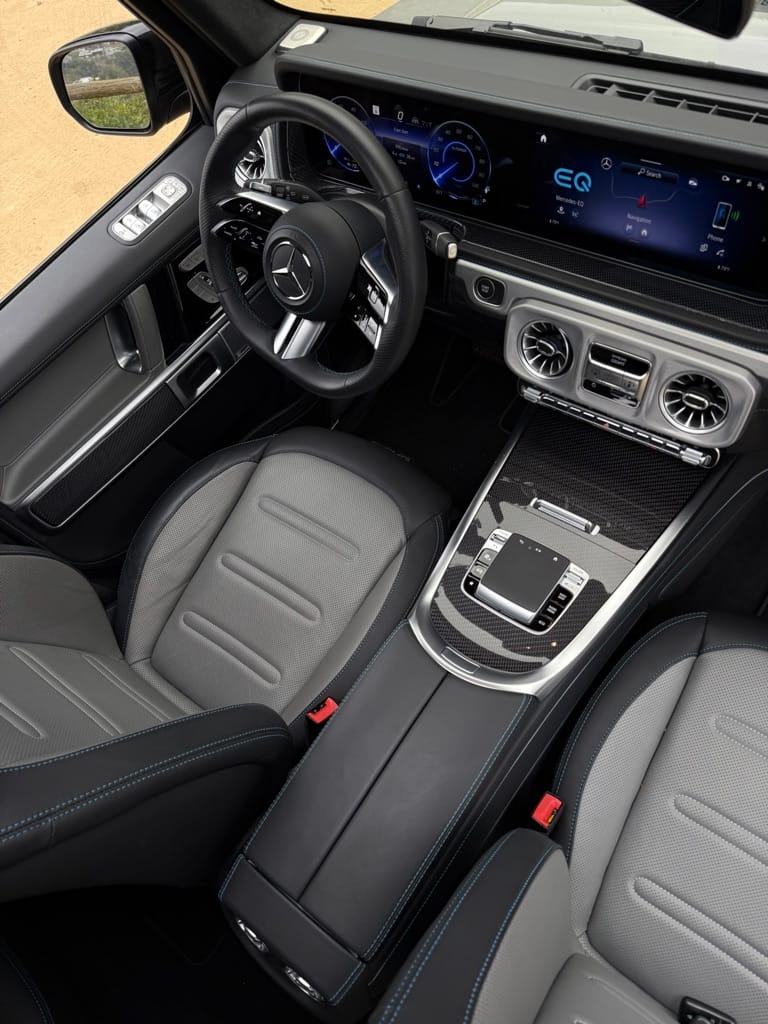
While it may mimic the G-Wagen experience - the bolt-action sound of the door latches, the commanding view over the hood, the indicators sitting like gun sights on the fenders - it runs on principles that dismantle the original machine’s logic. You expect the sound and fury, and it can be yours in a digitized fashion piped into the cabin. Me? I turned the sounds off and reveled in the silence. It was uncanny and awesome at the same time.
Charging was a breeze at my local DCFC. While the car can charge up to 200 kW, the 150 kW station gave me 25-80% in about 30 minutes or so, basically enough time to answer the many questions asked of me by other people charging their cars. The estimated 240-mile range is conservative; in the stop-start attrition of LA traffic, the regenerative braking extended that figure significantly.
The powertrain features four individual electric motors, one driving each wheel. This allows for torque vectoring impossible in a mechanical system, and enables the "G-Turn" you see in all the socials: the electric G doing spin after spin. Total output is more than the G 63: 579 horsepower and a 859 pound-feet of torque.
When Gilles Deleuze (sorry, more theory) wrote about the difference between "the virtual" and "the actual," he could have been talking about this car. With an internal combustion engine, the power is virtual—a promise contingent on gear selection and turbo spool. In the G 580, power is actual and on-demand.
Driving up Laurel Canyon and onto Mulholland, the weight is undeniable, but the center of gravity is lower than any combustion G-Wagen. You turn the wheel, and the mass follows without the usual top-heavy protest. On a straightaway on Mulholland, I went flat. The sensation was as disorienting as only an EV can be - a linear, body-shifting shove that propelled three tons of G forward without a gear change. It is seamless, a feat of physics wrapped in emotion.
On Sunday, I tested the G-Turn in a dusty lot off the 170. Holding the paddle shifter engages a mode where the left wheels spin forward and the right wheels spin backward. The truck rotates on its axis. Is it a parlor trick? You bet. But it's useful, perhaps, for extracting the vehicle from a narrow trail. Cooler still and a bit more useful is the "virtual differential lock," where the software mimics those three mechanical locker switches, distributing torque with millisecond precision to the wheel with the sturdy grip.
The perfection here is subtractive. The G 580 removes the vibration, the noise, and the mechanical delay. It is a G-Wagen reduced to its aesthetic form and propelled by silent, violent math. I loved it. Call me crazy, but I think it is the best G ever made.
G 580 with EQ Technology: from $163,200. $192,600 as tested.
Week Two: The G 550
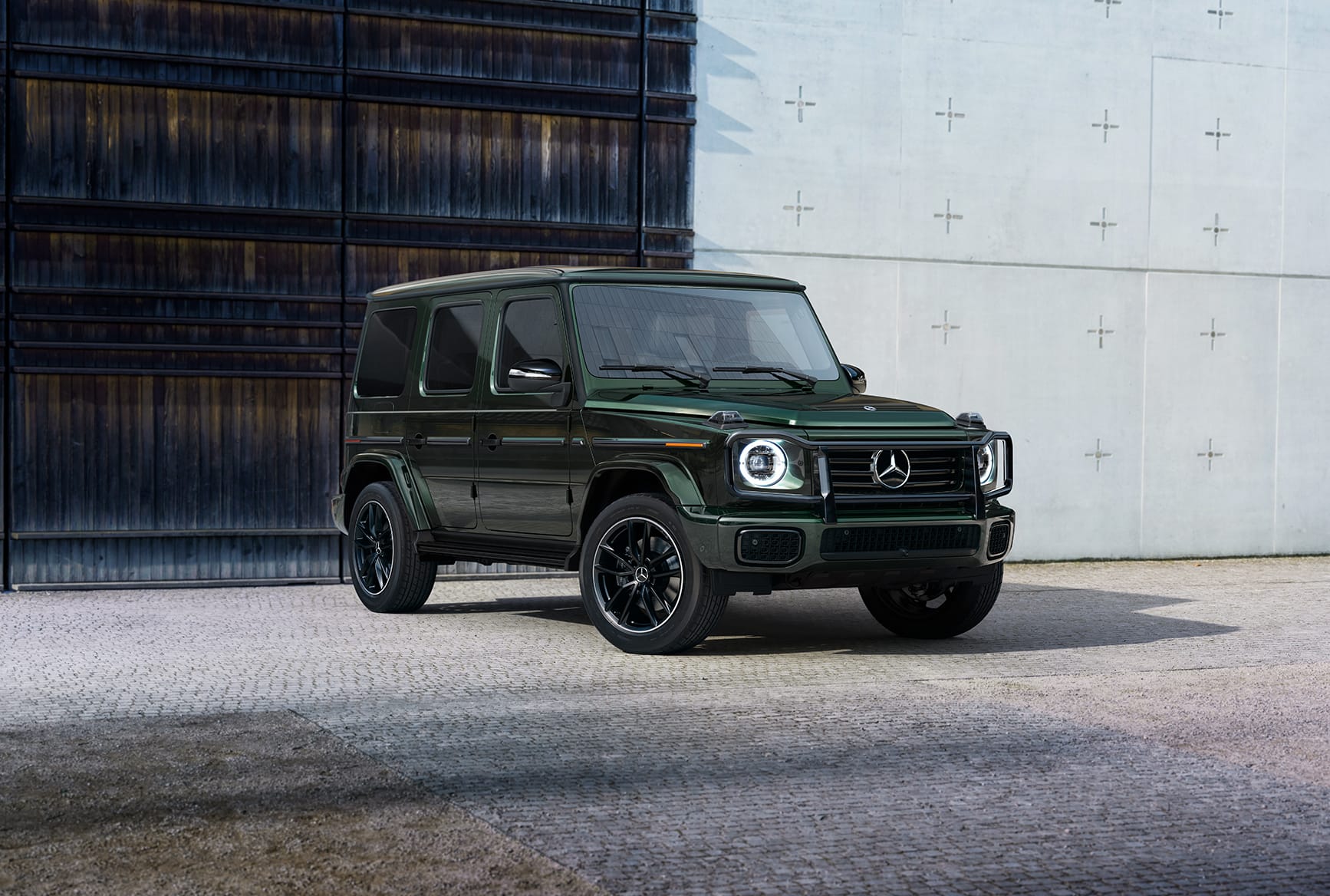
In the 70s, another French philosopher, Jacques Derrida the founder of "deconstruction" wrote about the idea of "the trace" - the presence of what's absent. The G 550 is defined by the trace of all G’s, past and present. The visual cues are subtly changed - a slightly different grille with a brush bar, less aggressive intakes - it’s a milder take on the G.
I spent the first few days adjusting to the rhythm of the mild-hybrid, gas-powered G 550. Where the G 580 responds instantly, the G 550 requires negotiation. You flog the throttle, the nine-speed transmission assesses the load, the turbochargers begin to spool (aided, thankfully, by an electric auxiliary compressor to mitigate turbo lag) in the 3.0L inline-6 and then the vehicle surges.
Thanks to the 443 horsepower and 413 lb-ft of torque - throw in the Integrated Starter Generator providing an additional 20 hp and 148 lb-ft for brief periods - you’re moving. It feels organic. Think about that sequence of events; it’s a mechanical cause and effect that the electric version removes.
I took the G 550 almost everywhere in LA. Driving west, past the radio towers on Mulholland, into the tight twisty corners, the differences in mass became apparent. The G 550 is roughly 1,300 pounds lighter than the EQ. It feels more agile on its toes and a lot less like a battering ram.
Again, Barthes comes to mind when he wrote about the Citroën DS: "The new object is immediately seen as being immediately perfect." While the G 550’s perfection is not immediate, it is cumulative.
It represents a rationalization of the G-Class. Idling at the intersection of Crescent Heights and Sunset, where Pandora's Box once stood, the vehicle felt alive. A faint vibration through the steering wheel, the hum of the HVAC, the mechanical engagement of the transmission. It connected me as the driver to the machine in a way the G 580 tended to isolate.
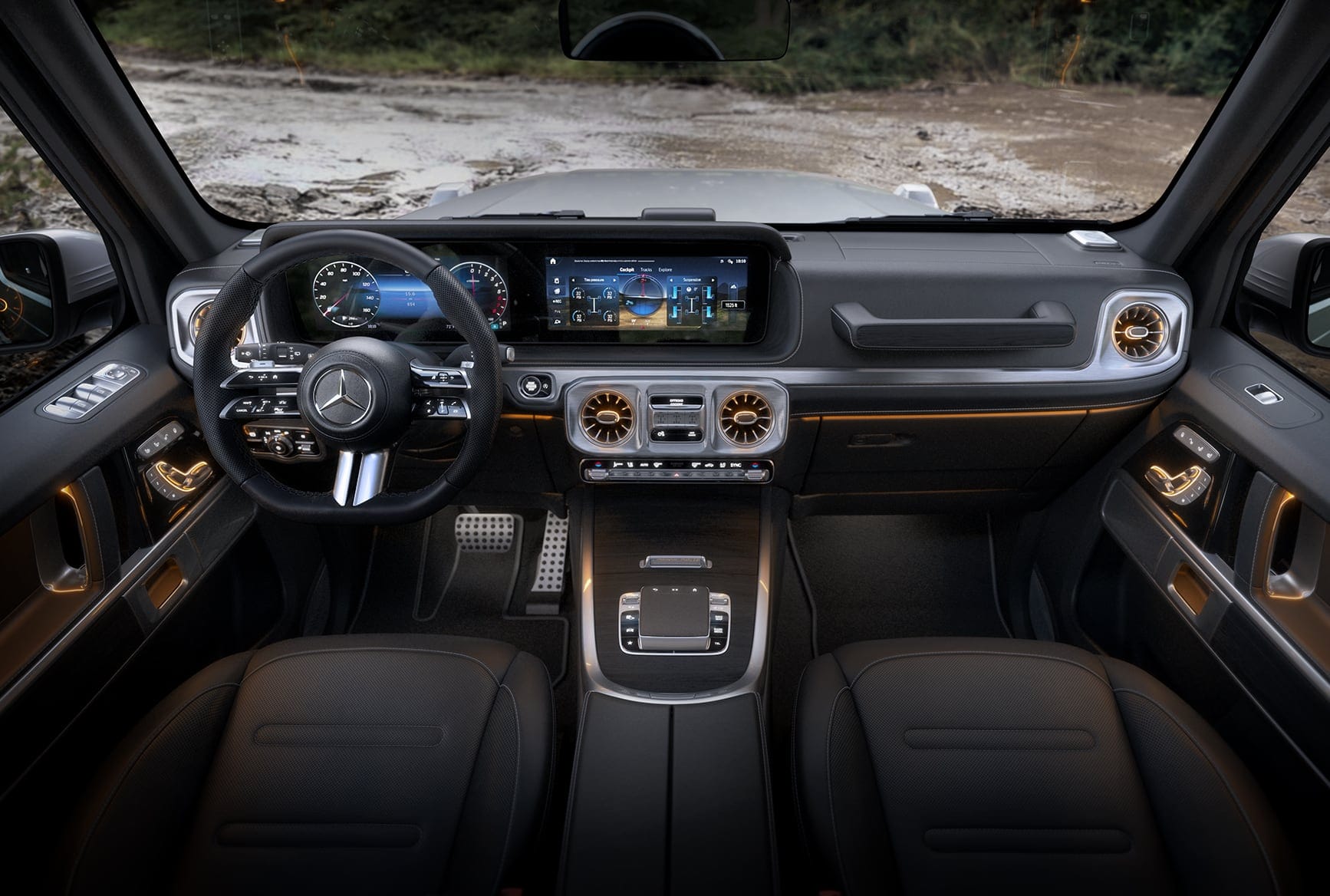
The G 550 really is the pragmatic choice here, a bridge between the analog past and the electric future. Also, I may add, it’s stunning. The model I tested was painted in Manufaktur Deep Green Non-Metallic over a Manufaktur Saddle Brown and Black leather interior with an optional Natural Grain Black-Flamed Ash wood trim and, to my delight, not an inch of carbon fiber anywhere.
The G 550 is the G-Wagen for the purist and for those who want all the capability without the theater.
G 550: from $153,900. $181,030 as tested.
Week Three: Mercedes-AMG G 63
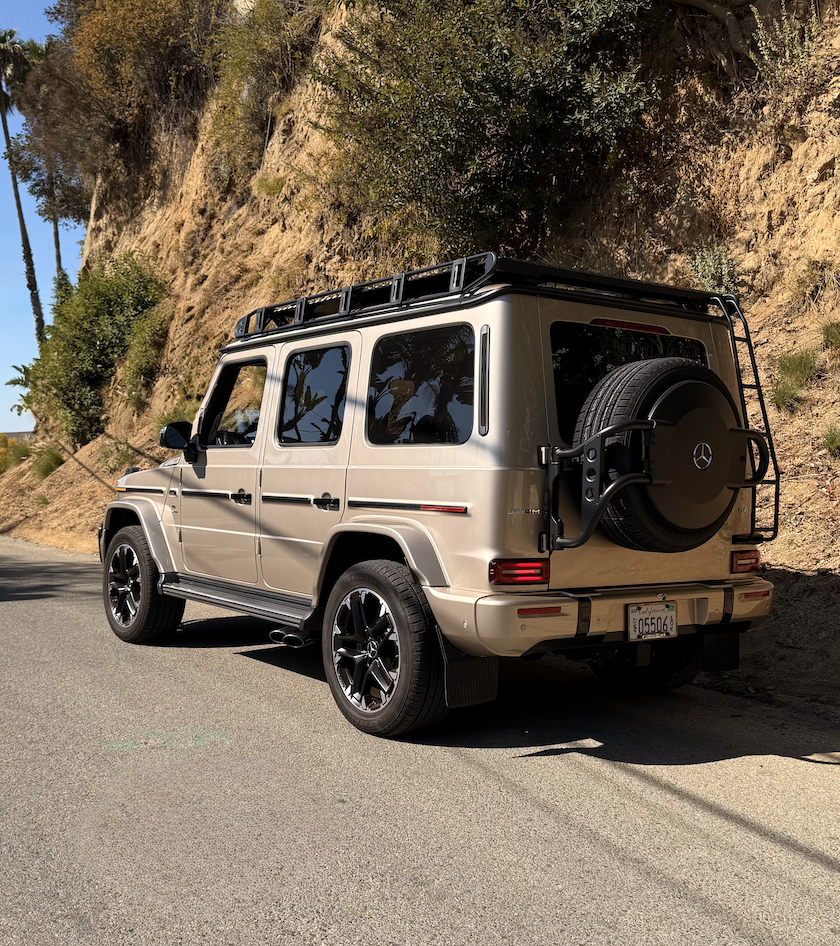
Jean Baudrillard, in “Seduction” wrote: "Nothing is more seductive than that which exists only to be seen." The G 63 exists to be seen, heard, and felt. The G 63 is Affalterbach’s performance engineering on tilt, delivering too much, all the time.
Under the hood sits a hand-built, ‘one man, one engine’ M177 4.0-liter twin-turbo V8 with 577 horsepower and 627 lb-ft of torque. Looking at the math, the numbers are similar to the electric G 580, but the delivery is radically different.
I let my wife drive us home from a party in Malibu. She is the ever cautious driver, but, on PCH, I asked her to punch it. With a bit of hesitation, she mashed the gas and off we went. Slowing down, she looked at me and said, “Ok, I get why people in LA love these…”
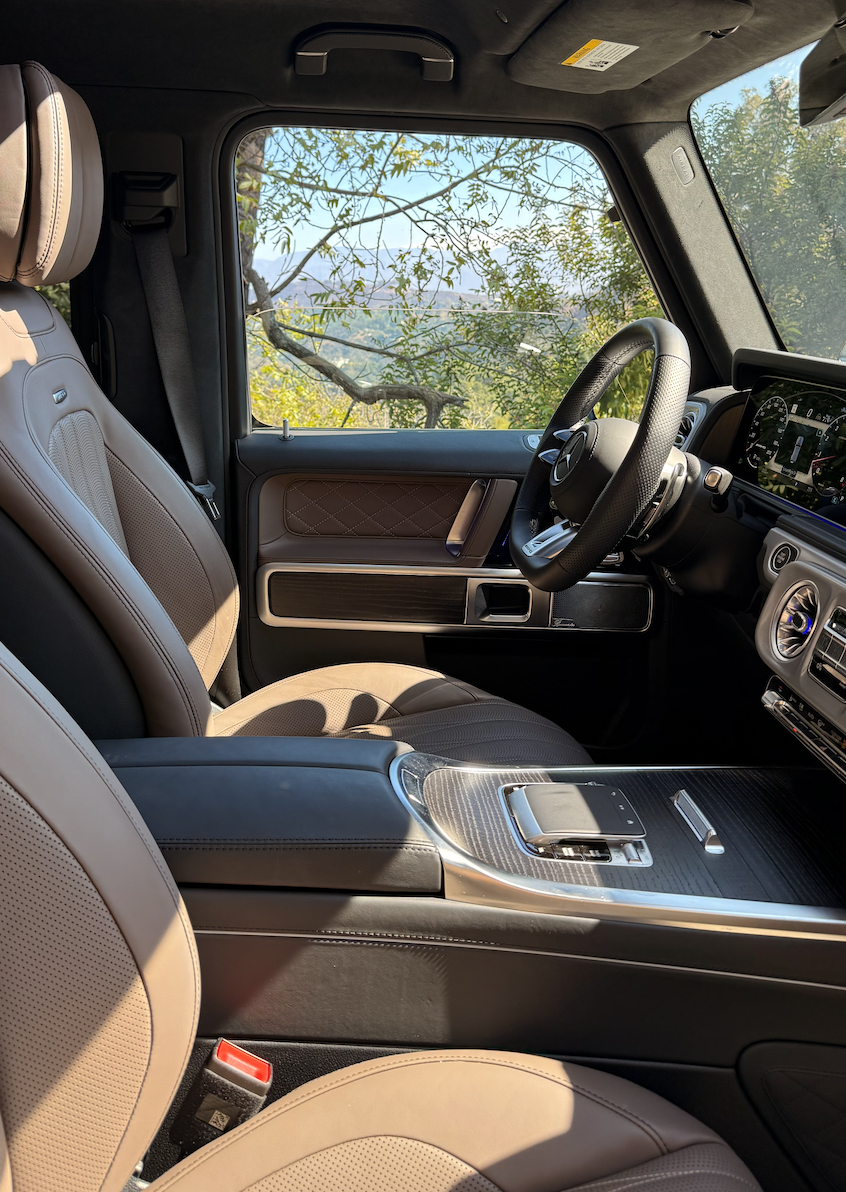
The G 63 delivers intensity, always. The steering is heavier than the other two models, with six-piston monobloc brake calipers that chomp down with immediate force. On the several long drives I took I left the transmission in manual mode just to hear the pops and crackles, coming to understand the engineered theater of the AMG with its fuel injected into the hot exhaust to specifically create the noise. I couldn’t get enough.
Alone, I took the G 63 up through a side canyon in Malibu, with its tightening radius turns and broken pavement. The G 63 stayed flat, a whirl of hydraulics counteracting the lateral forces. It may feel artificial but it's effective, like a skyscraper installed with earthquake dampers.
With the G 63, the sound is a central component of the experience, with its side-exit exhausts trumpeting a baritone resonance that reverberated off the canyon walls. The G 63 feels faster because of the violence of the delivery. The nose lifts, the rear squats and the gear changes snap you to attention. Where the G 580 is a sensory deprivation tank, the G 63 is an assault on the senses.
It is loud, brash, and totally unnecessary. What’s not to love?
G 63: from $195,500. $220,300 as tested.
One Perfect Thing x 3
While these three vehicles may share a chassis code, a shape, and a lineage - they all feature the same body-on-frame, the same differential locks (mechanical in the gas trucks, virtual in the electric), and the same commanding driving position - they are fundamentally different machines.
Barthes wrote about the ambiguity of automotive mythology - how cars mean different things simultaneously. The G-Class lineup illustrates this fractured meaning.
The G 580 EQ is a technical marvel, a silent fortress proving that electric can replicate - and better - mechanical capability. The G 550 is a rational evolution, smoothing the rough edges of the past. The G 63 is the celebration of excess, a defiance of the very future the G 580 embraces.
The perfection you find depends on the archetype you want to inhabit.
The G 580 EQ acts as the artifact for the technocrat: silent, impossibly fast and detached from mechanical struggle.
The G 550 serves the traditionalist: balanced and mechanical, retaining the soul of the G-Class without all the yelling and shouting.
The AMG G 63 remains the object for the exhibitionist: a seam-splitting V8-powered riot that refuses to go quietly into the orange sunsets of the Los Angeles’ dusk.
The choice isn't about which one is better, or even which one is more capable. They all conquer the grocery run and will get you parked up front at most LA valet stands with equal competence.
For me, the distinction lies in which version of the message you intend to broadcast. One perfect thing, fractured into three distinct dialects, proving that even in a world of absolutes, context is everything.